How to Plan a Saturday Route for Yard Sales Without Wasting Time
Apr 5, 2026
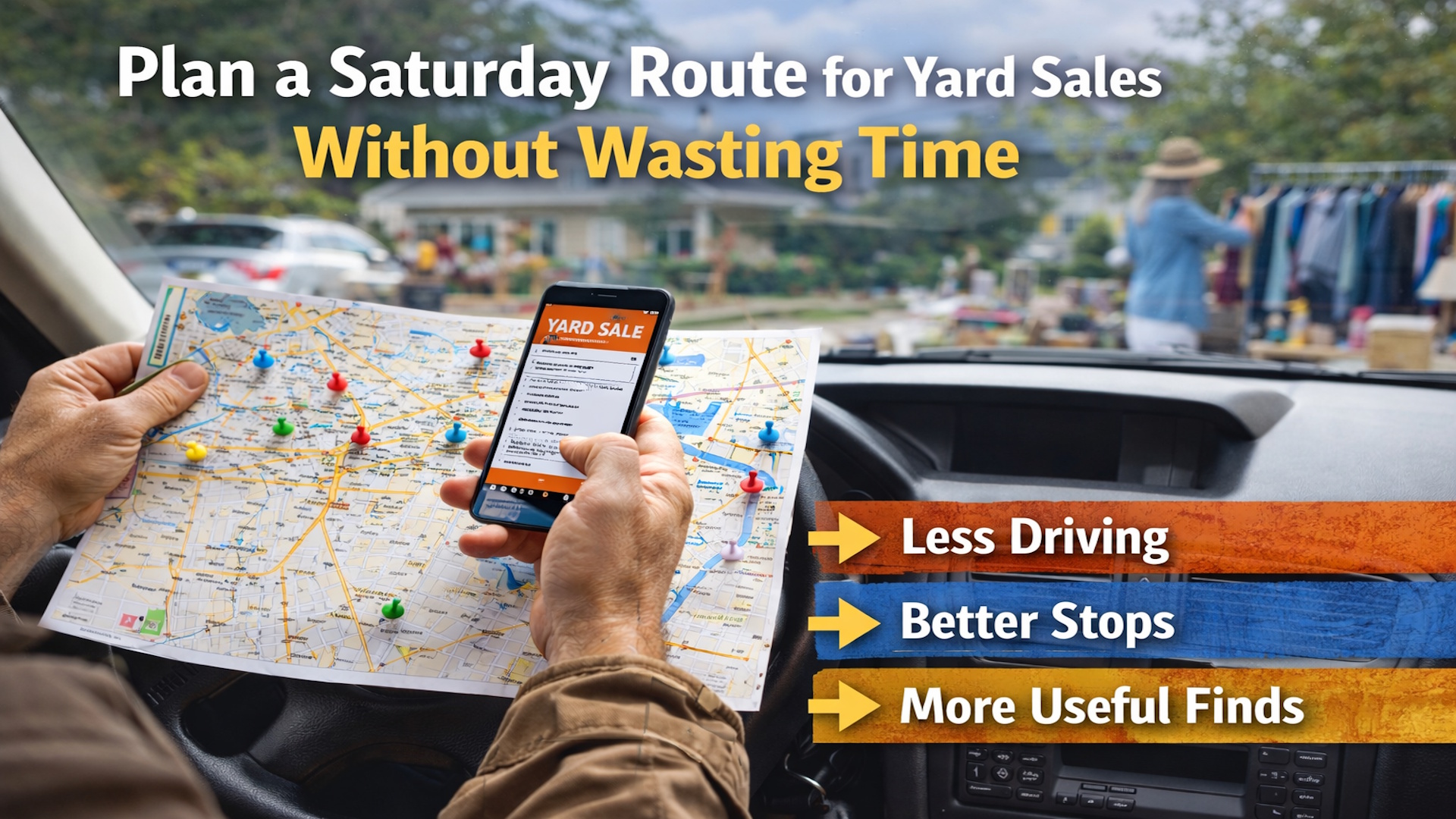
A good Saturday route can make the difference between a day full of solid stops and a day spent driving in circles. Most people lose time by doing too much, covering too much ground, or chasing weak sales that never had much to offer. The better approach is simple. Pick a zone, study the listings, and build a route that gives you the best chance at strong stops without burning half the morning on the road.
That matters even more in places like Erie, Cleveland, Buffalo, and Pittsburgh. Each area has its own traffic patterns, neighborhood layouts, and spread. In Erie, you can often cover more ground in less time if the listings are close. In Cleveland and Pittsburgh, route planning matters more because a few bad turns or long jumps between stops can eat up a huge part of the day. Buffalo can go either way, depending on the side of the metro you are shopping on. The common mistake is treating all listings like they have equal value. They do not.
Start With the Stops That Actually Matter
The first step is not mapping every sale you see. It is cutting the weak ones out. A short list of strong prospects beats a huge list of vague maybes every time.
Look at the wording in each listing. A sale that names real categories usually has a better chance of being worth the stop. Tools, records, books, vintage kitchen items, fishing gear, furniture, toys, and household goods tell you more than “something for everyone.” Multi-family sales can be productive, but only if the listing gives real detail. Estate sales and church sales also deserve attention because they often have more volume than a basic driveway setup.
Photos matter just as much. Clear photos with full tables, packed garages, bookshelves, or visible furniture usually beat listings with one blurry image or no images at all. If a seller took the time to show what is there, the stop has already given you a reason to consider it. If the listing says “lots of stuff” and shows almost nothing, that is usually a skip unless it fits neatly into the route.
Start by ranking each stop in three groups. Your first group is the high value list. These are the sales you would regret missing. The second group is a useful filler. These are nearby stops that may be worth a quick look if the first group goes fast. The third group is backup only. Those should never control the route.
This is also the point where local knowledge pays off. In Erie, one solid cluster can cover much of your morning. In Cleveland, the east side and west side should usually be treated as separate runs unless you have a very strong reason to cross over. In Buffalo, it often makes sense to stay locked into one corridor instead of bouncing from suburb to suburb. In Pittsburgh, bridges, traffic, and hills can wreck a route faster than people expect. Keep the plan tighter than your first instinct.
Build a Route That Cuts Driving and Protects Your Best Hours
The best shopping hours are early. That does not mean you need to show up at every sale right at opening, but it does mean your first hour or two should be protected. Do not waste that window on long drives, coffee stops, or weak sales that happen to be first on the map.
Pick one starting area and commit to it. A compact route with six good sales is better than a scattered route with fifteen. The goal is to move in a clean line or loop, not bounce around based on random excitement. Map the highest value stop first, then look for the next best sale nearby, then the next. Keep the jumps short. If one stop pulls you twenty minutes off course, it needs a very good reason to stay on the list.
Try to balance opening times with value. If one sale starts at 8 and looks excellent, that may be your anchor stop. If another strong sale starts at 9 and is five minutes away, that pairing makes sense. What does not make sense is driving thirty minutes to a maybe sale just because it opens earlier. People often confuse being first with being smart. A weak sale at 8 is still a weak sale at 8.
It also helps to think in time blocks instead of just addresses. Your first block is your priority run. That is where your best chance for tools, rare books, collectibles, quality housewares, or resale stock lives. Your middle block is for nearby filler stops and larger sales that still have plenty left. Your late block is for church sales, book sales, or bag sale situations where timing matters less and volume matters more.
Leave room for reality. Some sales are dead in three minutes. Some turn out far better than the ad suggested. Some listings are wrong about the address, the start time, or the size of the sale. A good route is not rigid. It is organized enough to keep you moving and flexible enough to recover from bad information.
Know What Makes a Stop Worth It and What Sends You Back to the Car
A smart route is only half the battle. You also need to know how long a stop deserves before you move on. One of the biggest time drains is staying too long at sales that never had much for you.
If you are shopping for books, media, tools, vintage items, or resale stock, learn to scan fast. The first look tells you a lot. Are the tables full or picked clean? Is there real depth, or just a thin spread of common items? Are prices reasonable enough to make the stop useful? Can you tell right away that the seller has more inside the garage, on side tables, or under the main setup? If the answer is no, move on.
That is another reason strong listings matter. They let you plan your Saturday route for yard sales with a real purpose instead of guessing at every driveway. A buyer who wants kids items, practical house goods, and low prices should not run the same route as a buyer looking for antiques, old paper, and rare books. A person hunting for flea market style volume needs a different plan than a person hoping for one or two quality estate sale stops.
The best local sale shoppers get more selective with time. They know a decent stop can still be the wrong stop if it pulls them away from better areas. In Erie, that may mean staying focused on a neighborhood cluster instead of chasing a single outlier on the edge of town. In Cleveland or Pittsburgh, it may mean refusing to cross into another section unless the listing looks clearly better than what you already have in front of you. In Buffalo, it may mean working one suburban pocket hard and saving the next pocket for another day.
A route should also match your energy. Do not build a ten stop plan that only works if nothing goes wrong. Most people do better with a sharp first list, a short backup list, cash in small bills, charged phone, and enough trunk space to avoid problems. If you are serious, keep boxes, packing paper, and a tote or two in the car. That matters more than people think, especially if furniture, lamps, framed art, or book lots show up early.
The best Saturday routes are not built on luck. They are built on good filters, short drives, realistic timing, and a willingness to skip weak stops. That approach works in Erie, Cleveland, Buffalo, and Pittsburgh because the basics do not change. Better planning leads to better sales, less wasted time, and a much better shot at getting home with something worth the trip.